Extrusion vs. Injection Molding: What Is the Difference?
Extrusion vs. Injection Molding: What Is the Difference?
In the world of plastic manufacturing, two heavyweights dominate the industry: extrusion vs injection moulding. While both processes involve melting thermoplastic materials and shaping them, they serve fundamentally different purposes.
Simply put, injection molding is the go-to method for creating three-dimensional, discrete parts like bottle caps or car bumpers. In contrast, extrusion molding is designed for manufacturing continuous, two-dimensional profiles like pipes, tubing, or window frames. Understanding these differences is critical for manufacturers deciding which process fits their product design.
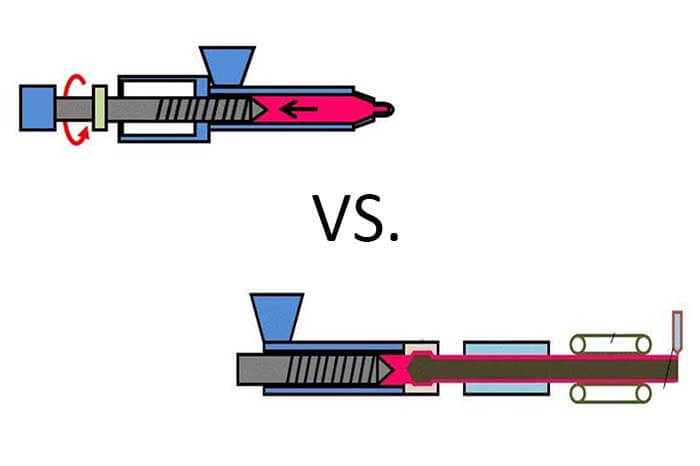
Extrusion vs. Injection Molding Principle
What is Injection Molding?
Injection molding relies on a cyclical process. The machine heats plastic pellets until they become a viscous liquid. This molten material is then injected under high pressure into a closed metal mold cavity. Once the plastic cools and solidifies, the mold opens, and the finished 3D part is ejected. It is a "stop-and-go" process.
What is Extrusion Molding?
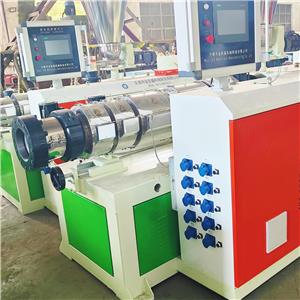
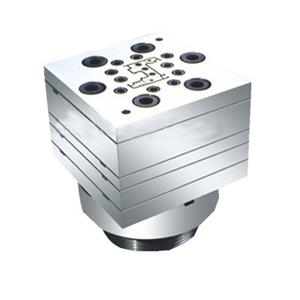
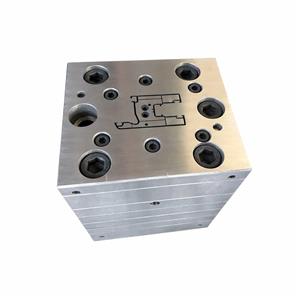
Extrusion moulding operates on a continuous principle. A screw pushes molten plastic through a heated barrel and forces it out through a shaped die (the extrusion mold). This creates a continuous profile with a constant cross-section, which is then cooled and cut to length. Unlike injection molding, extrusion does not involve a closed cavity mold.
Extrusion vs. Injection Molding Process
Injection Molding Process:
This involves four distinct stages:
Plasticization: Granules are melted.
Injection: The screw or plunger forces the melt into the closed mold.
Cooling: The part solidifies inside the mold.
Ejection: The mold opens, and the part is removed.
Extrusion Molding Process:
The extruded plastic molding process is more streamlined:
Plasticization: Similar to injection, pellets are melted in a barrel.
Extrusion: The screw pushes the material continuously through a die.
Sizing & Cooling: The profile exits the die and passes through a water bath or vacuum sizing tank to freeze its shape.
Extrusion vs. Injection Molding Time
Injection molding operates in cycles. Depending on the part's complexity and wall thickness, a cycle can take anywhere from a few seconds to several minutes.
Extrusion molding is a continuous process. Once the line is up and running, it can produce product non-stop for days. The speed depends on the cooling capacity and the cross-section of the profile.
Extrusion vs. Injection Molding Materials
While both processes use thermoplastics like PVC, PE, PP, and ABS, the specific material properties required differ significantly.
Difference in Liquidity (Flow Rate)
Injection molding requires materials with high liquidity (low viscosity) to ensure they can flow quickly into intricate mold cavities. Extrusion materials, however, are generally more viscous as they pass through an open die.
Melt Strength
This is a critical distinction. In extrusion, the plastic leaves the die in a hot, semi-molten state. It must have high "melt strength" to hold its shape before it fully cools. If the melt strength is too low, the profile will collapse. Injection molding does not require this, as the part cools inside a rigid mold.
Extrusion vs. Injection Molding Advantages and Disadvantages
Injection Molding
Pros: Capable of extremely complex 3D shapes; high precision; fully automated; ideal for mass production of discrete parts.
Cons: High initial tooling costs; expensive machinery; strict process control required.
Extrusion Molding
Pros: High efficiency for continuous products; lower tooling costs compared to injection molds; excellent for pipes, sheets, and films.
Cons: Limited to 2D cross-sections (cannot make a cup or a box); requires downstream equipment for cutting and winding.
Extrusion vs. Injection Molding Product Applications
Injection Molding Applications:
This method produces discrete items ranging from tiny gears to large automotive panels. Common examples include phone cases, plastic cutlery, syringes, and toys.
Extrusion Molding Applications:
Extrusion is the backbone of the construction and packaging industries. It is used for:
Pipes and Tubing: PVC water pipes, medical tubing.
Profiles: Window frames, weather stripping.
Sheets and Films: Plastic wrap, thermoforming sheets.
Specialty Mouldings: Complex multi-layer profiles like a hollow baseboard co-extrusion mold profile used in modern interior design.
Extrusion vs. Injection Molding Machine
Different Working Principles
The injection machine is a hydraulic or electric press that clamps a mold shut and injects plastic. The extruder is essentially a high-torque pump that pushes plastic through an open die.
For example, creating a wpc foaming baseboard mold requires a specialized extruder capable of handling foaming agents and precise temperature control to maintain the profile's density, something an injection machine cannot easily replicate continuously.
Classification
Injection Machines: Classified by clamping force (tonnage) and injection capacity.
Extruders: Classified by screw design (Single Screw vs. Twin Screw). Twin-screw extruders are often used for compounding and mixing materials efficiently.
Looking for High-Quality Extrusion Molds?
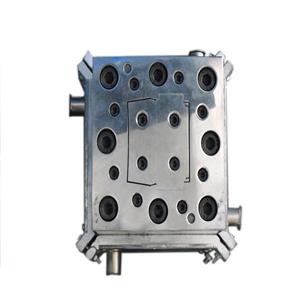
Whether you need complex co-extrusion dies or standard profile molds, precision is key. At JoinZeal, we specialize in top-tier extrusion tooling designed for longevity and performance.