PVC Foam Board Extrusion Mold Guide 2026
PVC Foam Board Extrusion Mold: Design Principles, Process Types & Supplier Criteria

Manager, Huangshi Zhongjie Mould Co., Ltd. · Published April 29, 2026
📑 Table of Contents
A PVC foam board extrusion mold is the core tooling component that determines the density uniformity, surface hardness, dimensional accuracy, and line speed of every rigid foam board your production line outputs. Get the die design wrong, and no amount of downstream adjustment — haul-off speed, calibrator cooling, extruder screw tuning — fully corrects the problem. This guide covers the two primary foaming processes, five engineering factors that separate high-performance molds from mediocre ones, and the criteria buyers should apply when selecting a PVC foam board extrusion mold supplier.
1. What Is a PVC Foam Board Extrusion Mold?
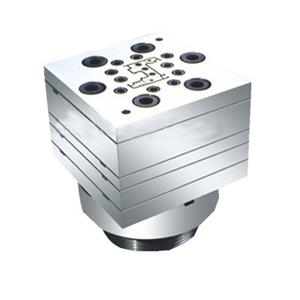
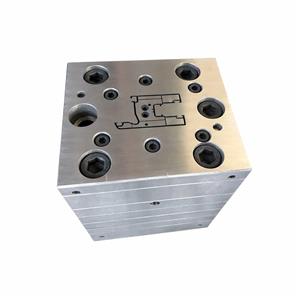
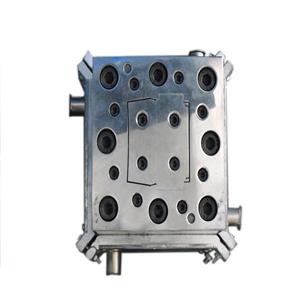
A PVC foam board extrusion mold — commonly called a foam die or foam board die — is a precision steel tool through which a PVC compound containing a chemical foaming agent is extruded under controlled heat and pressure to produce a rigid, low-density board with a continuous cellular core structure. The mold shapes the board's outer dimensions while allowing controlled internal expansion of the foamed melt as it exits the die and enters the calibrator.
PVC foam board is a lightweight, rigid panel material widely used in interior decoration, furniture production, signage, and construction cladding. Its low density (typically 0.4–0.7 g/cm³) is achieved by dispersing gas bubbles uniformly through the PVC matrix during extrusion. The mold design — specifically the flow channel geometry, die gap setting, and calibrator integration — determines whether those bubbles form uniformly or cluster into voids that weaken the board.
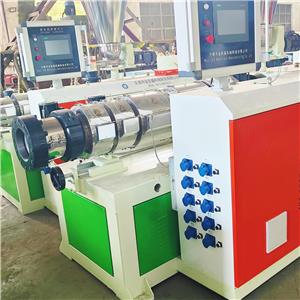
The complete mold system for PVC foam board production includes three matched components: the die head (melt distribution), the flat die or profile die (shaping section), and the calibration table with vacuum sizing plates. All three must be engineered together to handle the unique rheological behavior of foaming PVC melt.
2. Celuka vs. Free Foam: How the Process Changes the Mold
The two dominant PVC foam board production processes — Celuka and free foam — require fundamentally different mold architectures. Choosing the wrong die for your target process wastes capital and produces inferior boards.
| Feature | Celuka Process | Free Foam Process |
|---|---|---|
| Die exit gap | Smaller than final board thickness | Equal to or larger than final board thickness |
| Calibrator role | Constrains expansion, forms dense skin | Sizes after free expansion outside the die |
| Board surface | Harder, denser skin (0.9–1.0 g/cm³) | Softer skin, more uniform density throughout |
| Typical board density | 0.55–0.70 g/cm³ | 0.40–0.60 g/cm³ |
| Best suited for | Furniture panels, high-surface-quality signage | Construction cladding, cost-sensitive panels |
| Die complexity | Higher — requires precise die gap control | Medium — greater tolerance on die gap |
In the Celuka process, the melt expands inside the calibrator rather than freely in open air. This controlled expansion against chilled, polished steel plates produces a dense, smooth outer skin over a cellular core — the combination that makes Celuka boards popular for digital printing applications and furniture components requiring machining or edge profiling. The die must be engineered to exit the melt at precisely the right temperature and pressure to trigger expansion at the correct stage of the calibrator.
In the free foam process, the melt is allowed to expand beyond the die exit before entering the calibrator. This approach uses simpler tooling and tolerates a wider range of PVC foam formulations, making it the preferred method for high-volume commodity board production. However, foam cell uniformity is harder to control, and surface hardness is lower than Celuka boards of comparable density.
3. Five Engineering Factors That Determine PVC Foam Board Mold Performance
Across both foaming processes, five die engineering parameters drive the difference between a foam board mold that runs reliably at target output and one that generates persistent defects.
3.1 Die Gap Uniformity and Adjustability
The die gap — the distance between the upper and lower die lips — must be uniform across the full board width to within ±0.02 mm. Any variation creates density banding across the board cross-section. Professional foam board dies include adjustable lip bolts or thermal lip adjustment systems that allow fine-tuning during line startup without stopping production.
3.2 Flow Channel Balancing for Wide-Format Boards
PVC foam board dies are typically wide-format tools — common sizes range from 1,220 mm to 2,050 mm in board width. Distributing melt evenly across this width requires a coat-hanger manifold design with carefully calculated channel taper. An unbalanced channel causes the melt to race toward the center, producing boards that are thicker in the middle and thinner at the edges — a defect that cannot be corrected downstream.
3.3 Temperature Zoning Across the Die Body
PVC foam compounds decompose their chemical foaming agent (typically azodicarbonamide or sodium bicarbonate-based systems) within a narrow temperature window of 170–190 °C. Die temperature zones must be controlled to ±2 °C across this range. Premature decomposition inside the die — caused by a hot zone — creates gas pockets in the flow channel that score the die walls and produce splay defects on the board surface.
3.4 Die Steel Selection and Chrome Finishing
PVC melt is inherently corrosive to unprotected tool steel, particularly at foam processing temperatures where residual acid gases from decomposition can attack die surfaces. Die lips and flow channels in high-quality foam board dies are made from 40Cr or H13 steel, hard-chrome plated to a minimum depth of 0.025 mm, then polished to Ra ≤ 0.2 µm. This combination resists corrosion, reduces melt adhesion, and extends die service life by 40–60% compared to uncoated steel.
3.5 Calibrator Vacuum Distribution
The calibration table immediately downstream of the die uses vacuum suction to pull the expanding foam board against chilled sizing plates. Uniform vacuum distribution across the full board width is critical — localized vacuum loss causes surface depressions or wavy edges. Well-designed calibration tables use multiple independently controlled vacuum zones, allowing engineers to compensate for minor density variation