Co-Extrusion Mold vs Single Extrusion Mold | 2026 Guide
Co-Extrusion Mold vs Single Extrusion Mold: Which Is Right for Your Production Line?

Manager, Huangshi Zhongjie Mould Co., Ltd. · Published May 31, 2026
📑 Table of Contents
The choice between a co-extrusion mold and a single extrusion mold is one of the most consequential tooling decisions a plastic profile manufacturer makes. It affects product performance, capital expenditure, production complexity, and long-term material cost in equal measure. This guide compares co-extrusion molds vs single extrusion molds across seven practical decision factors — giving engineers and procurement managers a clear framework for matching die architecture to product requirements before committing to tooling investment.
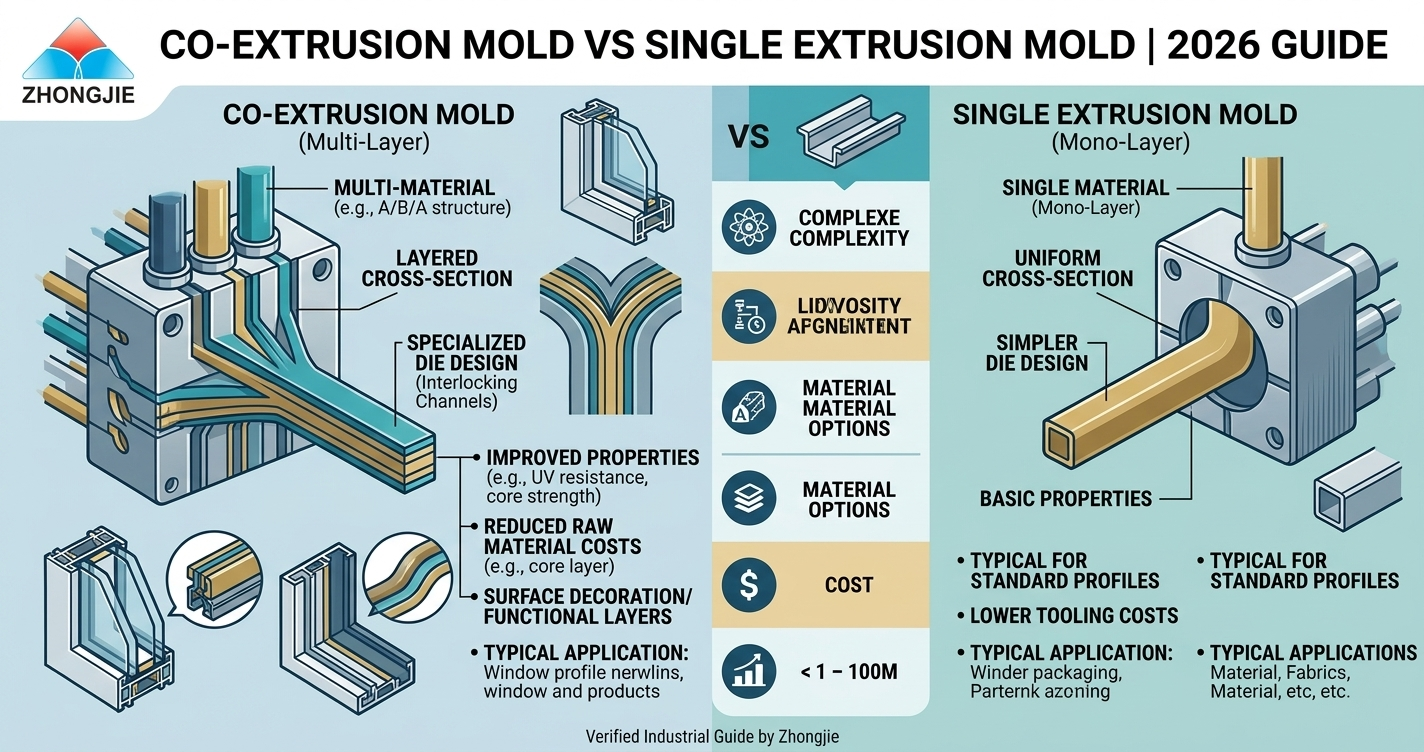
1. Defining the Two Technologies
A single extrusion mold — also called a mono-layer extrusion die — is a tool through which a single homogeneous polymer melt is shaped into a continuous profile with a fixed cross-section. One extruder feeds one material through one die. The resulting profile has uniform composition from surface to core.
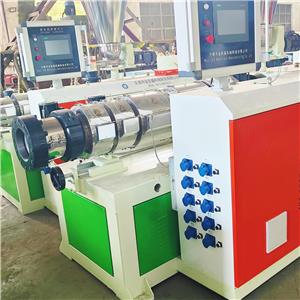
A co-extrusion mold is a multi-channel die that simultaneously shapes two or more polymer melts — each fed by a dedicated extruder — and merges them at a precisely controlled point inside or just before the die exit. The resulting profile contains two or more distinct material layers bonded together in a single continuous pass. Each layer retains its own material properties while combining with adjacent layers to produce performance characteristics that no single material can deliver alone.
Both technologies are well established across PVC window profiles, WPC decking, foam board panels, cable trunking, and pipe extrusion. The question is never which technology is superior in the abstract — it is which architecture best serves the specific product, production volume, and market requirement at hand.
2. How a Co-Extrusion Mold Differs Structurally From a Single Extrusion Mold
Understanding the structural differences between the two die types clarifies why co-extrusion tooling costs more, requires more engineering, and demands a higher level of operator skill.
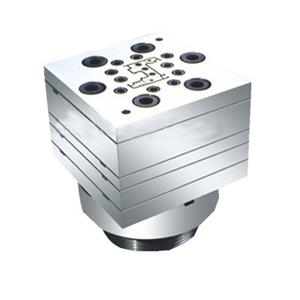
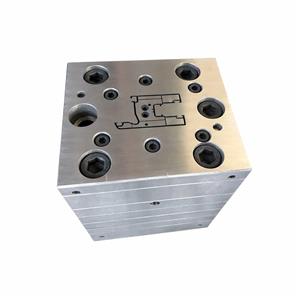
A single extrusion mold consists of a die head, a flow channel manifold, and a die land — three components designed to receive one melt stream, distribute it evenly across the profile width, and shape it at the exit. The entire system handles one material at one temperature and one viscosity. Design complexity scales with profile geometry, but the thermodynamic problem is a single-variable one.
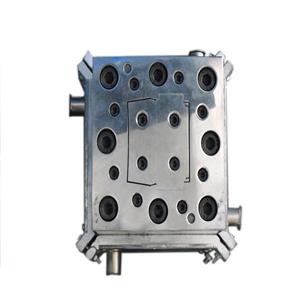
A co-extrusion mold adds one or more independent flow channels — one per additional material layer — that run parallel to the main channel inside the die body. These secondary channels must deliver their respective melt streams to a merging point at precisely controlled temperature, pressure, and flow rate. At the merge zone, two or more materials in a semi-molten state must join cleanly without intermixing, delamination, or flow instability.
This creates three engineering challenges absent in single extrusion tooling:
Rheological matching — Melt viscosity of both materials at the merge point must be compatible. A large viscosity mismatch causes the lower-viscosity layer to encapsulate the higher-viscosity one, distorting the layer interface and producing visual streaks or structural weaknesses.
Thermal isolation between channels — The two melt streams may require different processing temperatures. Die body design must prevent thermal crossover between adjacent channels while maintaining each material within its optimal processing window.
Synchronized pressure balance — Output rate from each extruder must be matched continuously to keep the layer thickness ratio stable across the full production run. Pressure fluctuations in one channel instantly affect the layer geometry at the merge zone.
3. Head-to-Head Comparison: 7 Key Decision Factors
The table below provides a direct comparison across the seven factors that matter most to buyers choosing between these two die types:
| Decision Factor | Single Extrusion Mold | Co-Extrusion Mold |
|---|---|---|
| Tooling cost | Lower — single flow channel system | 30–80% higher — multiple channels, merge zone engineering |
| Capital equipment | One extruder required | Two or more extruders required |
| Lead time | 35–45 days typical | 45–60 days typical |
| Product performance | Properties of one material only | Combined properties of two+ materials |
| Surface quality | Depends on core material surface behavior | Cap layer independently optimized for surface quality |
| Material flexibility | Single compound per run | Core and cap can use different compounds simultaneously |
| Operator complexity | Lower — one set of process parameters | Higher — two synchronized parameter sets required |
No single row in this table determines the decision. The right choice depends on weighting these factors against your specific product requirement, market price point, and available capital. Sections 4 and 5 below map these factors to concrete go/no-go criteria.
4. When to Choose a Co-Extrusion Mold
A co-extrusion mold justifies its higher tooling and equipment cost when the product specification requires performance characteristics that a single material cannot deliver economically. Four scenarios consistently favor co-extrusion tooling:
4.1 UV and Weather Resistance Without Premium Core Material Cost
UV stabilizers and weathering additives are expensive. Adding them throughout a thick profile core at the loading level needed for outdoor durability raises compound cost significantly. Co-extrusion solves this by applying a thin cap layer — typically 0.3–1.0 mm — of UV-stabilized or ASA-based compound over an economical PVC or WPC core. The cap provides full outdoor protection; the core provides structural bulk at lower cost per kilogram.
4.2 Surface Hardness Over a Foam Core
PVC foam board and WPC foam profiles have inherently soft surfaces due to their cellular core structure. A co-extruded solid PVC or PMMA cap layer over a foam core produces a board with the hardness, printability, and scratch resistance of solid sheet combined with the lightweight and insulating properties of foam — a combination no single-layer die can achieve.
4.3 Color Flexibility Without Full-Compound Pigmentation
Pigmenting a full-thickness PVC or WPC profile throughout requires high pigment loading and makes color changes slow and wasteful. A co-extruded color cap layer uses a fraction of the pigment and can be changed independently of the core compound. For window profile manufacturers supplying multiple color options, this translates into faster changeovers and lower color material inventory.
4.4 Bi-Material Functional Design
Some profiles require hard and soft regions in the same cross-section — for example, a rigid PVC structural body with a soft TPE seal lip extruded simultaneously. This is only achievable with a co-extrusion die. The same principle applies to profiles requiring one side with a high-friction texture and another with a smooth surface.
5. When a Single Extrusion Mold Is the Better Choice
A single extrusion mold remains the correct choice across a wider range of applications than its simpler reputation suggests. Four conditions strongly favor mono-layer tooling:
5.1 Commodity or Price-Sensitive Markets
In markets where profile price is the dominant purchasing criterion — municipal drainage pipe, cable trunking, basic hollow panels — co-extrusion adds tooling cost and complexity without generating a price premium that buyers will pay. Single-layer tooling with optimized die design and efficient compound selection delivers better return on investment.
5.2 Low-Volume or Custom Profile Production
Short production runs for custom architectural profiles, replacement dies for older extrusion lines, or specialized industrial profiles rarely justify co-extrusion tooling cost. A single extrusion mold amortizes over fewer meters of output and can be redesigned quickly if the profile specification changes.
5.3 Material Compatibility Constraints
Not all polymer pairs bond reliably at the co-extrusion merge zone. Materials with large differences in melt temperature, viscosity, or surface energy require extensive adhesion testing and sometimes a tie-layer compound — adding a third channel and further complexity. When material compatibility is borderline, single extrusion with a post-extrusion coating or lamination process is often more reliable.
5.4 Limited Extruder Capacity on the Production Floor
Co-extrusion requires a dedicated secondary extruder — typically a 25–45 mm diameter single-screw machine for cap layer applications. If floor space, capital, or extruder availability is constrained, a single extrusion mold producing a solid or filled profile is the practical choice until capacity expands.
6. Real-World Applications Across PVC, WPC, and Foam
The following examples illustrate how the co-extrusion mold vs single extrusion mold decision plays out across the product categories most relevant to buyers of Chinese extrusion tooling:
| Product | Recommended Die Type | Primary Reason |
|---|---|---|
| UPVC window main frame (white, indoor-facing) | Single extrusion | Full-body white PVC, no cap needed, cost-efficient |
| UPVC window profile (dual-color, outdoor-facing) | Co-extrusion | ASA color cap on white PVC core; UV resistance without full-body pigmentation |
| WPC decking — indoor / low-UV environment | Single extrusion | Standard WPC compound adequate; simpler tooling preferred |
| WPC decking — outdoor / coastal exposure | Co-extrusion (360° cap) | HDPE or ASA cap provides UV, stain, and moisture resistance on all four sides |
| PVC foam board — signage / digital print | Co-extrusion (top-side cap) | Solid PVC cap provides hard, smooth print surface over foam core |
| PVC cable trunking | Single extrusion | Uniform PVC, price-driven commodity market |
| PVC door profile with soft-seal lip | Co-extrusion (PVC + TPE) | Rigid body with integral flexible sealing element in one pass |
At Huangshi Zhongjie Mould Co., Ltd., our engineering team has designed both co-extrusion and single extrusion dies across all the product categories above. With over 16 years of continuous mold manufacturing experience — and senior engineers each holding 20+ years of hands-on die design expertise — we advise buyers on die architecture selection as part of our standard pre-quotation consultation, at no additional charge.
7. Frequently Asked Questions
Q: Can an existing single extrusion mold be converted to co-extrusion?
A: Rarely, and generally not recommended. A co-extrusion die requires a secondary flow channel machined into the die body, a merge zone engineered for the specific material pair, and thermal isolation between channels. Retrofitting an existing single die is technically complex and usually costs more than commissioning a purpose-built co-extrusion die.
Q: How much thicker does a co-extrusion cap layer need to be to provide effective UV protection?
A: For outdoor PVC and WPC profiles, a co-extruded ASA or PMMA cap layer of 0.4–0.8 mm provides effective UV protection for 10–15 years under typical temperate-climate exposure conditions. Cap layers below 0.3 mm are difficult to control dimensionally and may not provide consistent long-term coverage.
Q: Does a co-extrusion mold require a completely different calibrator compared to a single extrusion mold?
A: The calibrator geometry remains profile-specific in both cases. However, a co-extrusion calibrator must be designed with the cap layer's different thermal conductivity in mind — particularly for cap materials such as ASA or PMMA, which cool at different rates than the PVC core beneath them. A co-extrusion-specific calibrator designed alongside the die delivers better dimensional stability than adapting a single-extrusion calibrator.
Q: What is the typical price premium for a co-extrusion mold over a comparable single extrusion mold?
A: For a standard UPVC window or WPC decking profile, a co-extrusion die typically costs 40–70% more than the equivalent single extrusion die for the same profile geometry. The premium reflects additional machining time, merge zone engineering, and pre-shipment testing with both materials running simultaneously.
8. Conclusion & Next Steps
The co-extrusion mold vs single extrusion mold decision is not a question of which technology is more advanced — it is a question of which architecture best matches your product's performance requirements, your production line's capacity, and your market's price tolerance. Single extrusion tooling wins on cost, simplicity, and versatility for commodity and mid-range profiles. Co-extrusion wins when surface performance, material efficiency, or bi-material function justifies the higher tooling and equipment investment.
The clearest signal that co-extrusion is warranted: your product requires a surface property — UV resistance, color depth, surface hardness, or soft-touch sealing — that the core material cannot deliver at an acceptable compound cost. The clearest signal that single extrusion is sufficient: the profile's performance requirements can be fully met by one optimized compound, and market pricing does not support the premium that co-extrusion typically commands.
At Huangshi Zhongjie Mould Co., Ltd., we manufacture both co-extrusion and single extrusion molds for PVC, WPC, PE, and foam applications. Our team holds a High-Tech Enterprise Certificate and is a member of the Extrusion Mould Association of Huangshi City, with verified export customers across Europe, the Americas, the Middle East, and Southeast Asia. If you are evaluating die architecture for a new profile, contact our extrusion mold engineering team with your profile drawing and material specification. We will recommend the right tooling approach and return a detailed technical proposal within 48 hours.
Request a Free Die Consultation →
Sources & References
The following sources were referenced in the preparation of this article:
Plastics Technology Online — Co-Extrusion Basics: Flow Channel Design and Merge Zone Engineering
Society of Plastics Engineers (SPE) — Extrusion Division Technical Library
CEN — EN 12608: Unplasticized PVC Profiles for Windows and Doors Classification & Requirements
ASTM International — D7032 Standard Specification for WPC Deck Boards & Guardrail Systems
CHINAPLAS 2026 — International Exhibition on Plastics and Rubber Industries, Shanghai
K Trade Fair Düsseldorf — World's Leading Trade Fair for Plastics & Rubber