WPC Decking Extrusion Line Setup Guide 2026
WPC Decking Extrusion Line Setup: Equipment, Process Parameters & Commissioning Guide for 2026

Manager, Huangshi Zhongjie Mould Co., Ltd. · Published May 31, 2026
📑 Table of Contents
A WPC decking extrusion line setup involves far more decisions than selecting a single machine. Every component in the line — from the raw material drying system to the final cut-off saw — must be specified, sized, and sequenced to match the decking board profile, target output rate, and WPC compound being processed. Get one element wrong, and the entire line underperforms regardless of how well the remaining equipment is chosen. This guide walks engineers and plant managers through each stage of a WPC decking extrusion line setup, from equipment selection through commissioning, with the process parameters and decision criteria that experienced WPC producers use in practice.
1. What Is a WPC Decking Extrusion Line?
A WPC decking extrusion line is a sequence of connected machines and tooling through which a wood-plastic composite compound — a blend of wood flour, thermoplastic polymer, and functional additives — is continuously processed from raw material into finished decking boards ready for cutting, stacking, and shipment. Wood-plastic composite (WPC) extrusion is a manufacturing process in which wood fibers or wood flour are combined with thermoplastics such as PE, PVC, or PP, then melted and shaped through a die to produce a structural profile with consistent cross-section geometry.
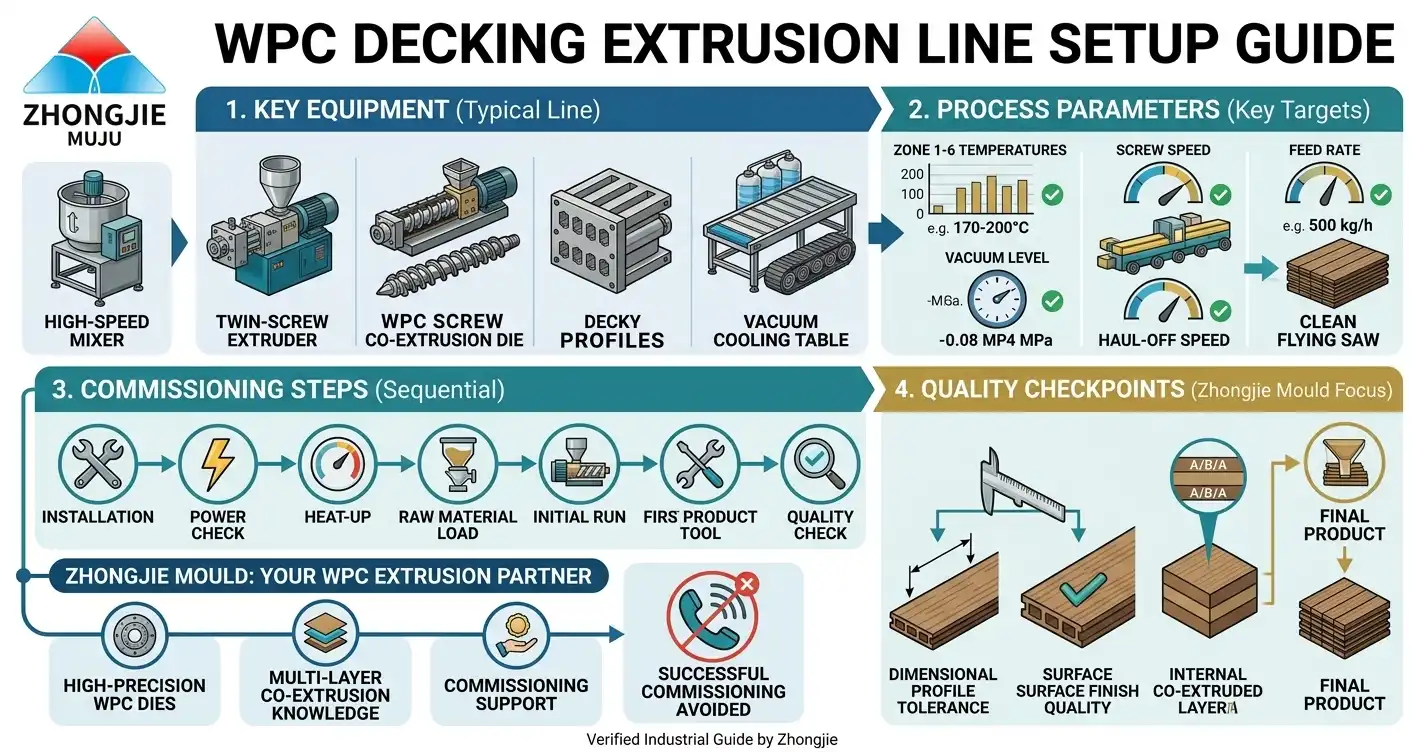
A complete WPC decking extrusion line typically includes seven functional stations working in sequence:
Raw material metering and mixing system
Drying or dehumidifying unit (for moisture-sensitive wood flour)
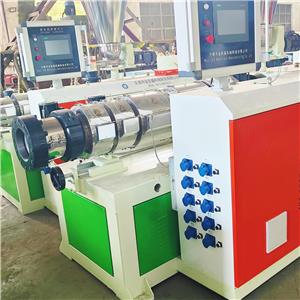
Twin-screw or conical twin-screw extruder
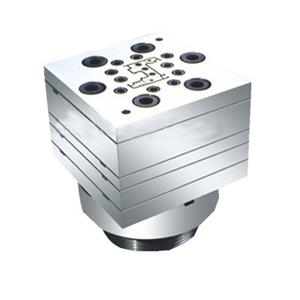
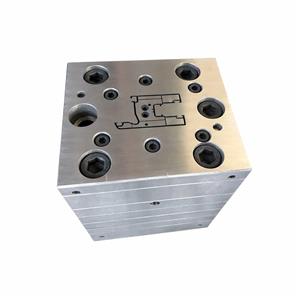
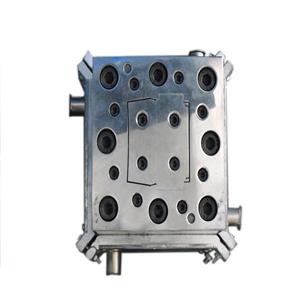
Extrusion die and die head
Vacuum calibration and cooling table
Haul-off (caterpillar puller) unit
Cut-off saw and stacking table
For co-extruded decking with a protective cap layer, a secondary single-screw extruder feeds a cap-layer co-extrusion die mounted ahead of the calibrator, adding an eighth station to the line. Each station's capacity must be matched to the extruder's output rate — the most common cause of bottlenecks in poorly planned WPC decking line setups.
2. Core Equipment in a WPC Decking Extrusion Line Setup
Each piece of equipment in the line performs a distinct function. Misspecifying any unit — even an auxiliary one like the haul-off — causes process instability that manifests as dimensional variation, surface defects, or premature tool wear. The table below summarizes the core equipment, typical specifications for a mid-scale WPC decking line, and the key variable each unit controls:
| Equipment Station | Typical Specification | Key Variable Controlled |
|---|---|---|
| Conical twin-screw extruder | SJSZ-65/132 or SJSZ-80/156 | Output rate, melt temperature, mixing quality |
| WPC extrusion die | Custom per decking profile, nitrided 38CrMoAl or H13 steel | Profile geometry, wall thickness, surface finish |
| Vacuum calibration table | 4–6 m length, multi-zone vacuum, chilled water ≤ 15 °C | Dimensional accuracy, surface hardness |
| Spray cooling tank | 3–6 m, ambient water cooling | Core temperature reduction before haul-off |
| Caterpillar haul-off | Pull force 5–15 kN, speed 0.5–5 m/min | Line speed, longitudinal tension, board straightness |
| Cut-off saw | Travelling saw, encoder-based length control ±1 mm | Board cut length accuracy |
| Secondary extruder (co-ex) | Single-screw, 25–45 mm, for cap layer compound | Cap layer thickness, color consistency |
The extruder model number convention used in China identifies screw diameter and screw center distance. An SJSZ-65/132 machine has a 65 mm small-end screw diameter and 132 mm large-end diameter — a mid-capacity conical twin-screw commonly used for 140 mm × 25 mm hollow decking boards at outputs of 150–250 kg/h. Larger SJSZ-80/156 machines suit wider boards or higher-throughput production requirements.
3. Choosing the Right Extruder for WPC Decking
Extruder selection for WPC decking production centers on one decision: conical twin-screw vs parallel twin-screw. Both are used in WPC applications, but they differ in processing behavior in ways that matter for decking board quality:
Conical twin-screw extruders — The tapered screw design provides high compressive force in the feed zone, making conical twin-screws well suited to direct powder compound feeding from a high-speed mixer. Lower screw speed (typically 15–40 RPM) reduces shear heating, which is critical for wood-fiber-sensitive WPC compounds. This is the dominant extruder type for PVC-based WPC decking lines.
Parallel co-rotating twin-screw extruders — Higher screw speed (200–600 RPM) delivers intensive distributive mixing, making parallel twin-screws the preferred choice for PE-based or PP-based WPC compounds where pelletized feedstock is used and thorough dispersion of wood flour in the polymer matrix is the primary processing objective.
For PE-based WPC decking — the dominant formulation in the North American and European outdoor decking market — a parallel co-rotating twin-screw extruder paired with a separately produced WPC pellet compound is the standard configuration. For PVC-based WPC, a conical twin-screw extruder processing powder compound directly from a high-speed mixer is more common and more cost-effective.
Screw wear is an ongoing cost in WPC decking production. Because WPC contains abrasive mineral fillers and wood flour, screw and barrel wear is measurably higher than in standard PVC extrusion. Specifying bimetallic barrel liners and tungsten carbide screw coating at initial equipment purchase reduces long-term maintenance cost significantly.
4. Die and Calibrator Selection for WPC Decking Profiles
The extrusion die and vacuum calibrator are the two tooling components with the greatest influence on finished decking board quality. Both must be designed specifically for the target decking profile — they are not interchangeable between different board widths or hollow versus solid cross-sections.
4.1 Hollow vs. Solid Decking Die
Most commercial WPC decking boards use hollow profiles — typically two to four internal chambers — to reduce weight and material cost without sacrificing flexural strength. A hollow decking die uses internal mandrels supported by spider legs or bridge elements to create the chambers. Each mandrel support creates a weld line in the extrudate where split melt streams rejoin. The die must be designed so weld line pressure is sufficient to produce a mechanically sound bond — otherwise the weld line becomes a failure plane under load.
Solid decking boards are heavier and more expensive per meter but are preferred in high-load applications such as dockside decking, heavy-traffic commercial areas, and structural applications where ASTM D7032 span ratings must be achieved without the complexity of hollow chamber design.
4.2 Die Steel and Surface Treatment for WPC
WPC decking dies operate under conditions far more abrasive than standard PVC extrusion. Die flow channels and land surfaces must withstand continuous contact with wood flour particles and mineral fillers at processing temperatures of 160–190 °C. Nitrided 38CrMoAl steel with a surface hardness of HV 900+ is the baseline specification. For high-fill WPC formulations (wood flour content above 60%), hard-chrome plating over H13 steel adds another layer of wear protection and extends die life by 30–50% compared to nitriding alone.
4.3 Calibrator Design for WPC Decking
The vacuum calibration table for WPC decking must handle a wider, heavier profile than most other plastic extrusion applications. A 140 mm × 25 mm hollow decking board — one of the most common commercial sizes — exits the die at temperatures of 160–175 °C and must be cooled to below 60 °C before the haul-off grips it. A calibration table of 4–6 m with independent vacuum zones and chilled water at 10–15 °C is standard. Undersized calibrators — a common cost-cutting mistake — force slower line speeds and reduce output by 20–40% below the extruder's rated capacity.
5. Key Process Parameters and Line Speed Targets
Process parameters for a WPC decking extrusion line must be established for each specific combination of extruder, die, compound, and board geometry. The values below represent typical starting-point targets for a PE-based WPC hollow decking board (140 mm × 25 mm, two chambers, approximately 50% wood flour content):
| Parameter | Typical Starting Range | Primary Effect |
|---|---|---|
| Zone 1 barrel temperature | 150–160 °C | Feed melting, fiber wetting |
| Zone 2–3 barrel temperature | 165–175 °C | Homogeneous melt, dispersion |
| Die head temperature | 170–185 °C | Melt flow balance, surface finish |
| Screw speed (conical) | 18–32 RPM | Output rate, shear heat generation |
| Calibrator water temperature | 10–15 °C | Surface hardness, dimensional stability |
| Vacuum level (calibrator) | 0.04–0.07 MPa | Profile surface contact, dimensional accuracy |
| Haul-off speed | 0.8–2.5 m/min | Board dimensions, draw-down ratio |
| Line output | 150–280 kg/h | Production capacity per shift |
These values shift significantly with changes in wood flour content, polymer type, moisture level of the compound, and ambient temperature. A compound moisture content above 0.5% — common when wood flour is improperly stored — causes visible surface porosity and internal voids that no downstream adjustment corrects. Pre-drying WPC compound or wood flour to below 0.3% moisture before feeding the extruder is a non-negotiable step in any professional WPC decking line setup.
6. Commissioning Sequence and Common WPC Decking Line Startup Mistakes
Commissioning a new WPC decking extrusion line follows a defined sequence. Skipping or compressing any stage produces unreliable baseline data and makes subsequent troubleshooting difficult. The recommended sequence:
Dry run verification — Run all mechanical systems without material to confirm extruder rotation direction, haul-off grip pressure, saw trigger operation, and vacuum pump function. Correct mechanical faults before introducing compound.
Temperature soak — Heat the extruder barrel, die head, and die to target temperatures and hold for a minimum of 30 minutes before feeding material. Insufficient soak time causes cold slugs in the die that score flow channel walls and block the die exit.
Purge with virgin polymer — Feed neat PE or PVC (without wood flour) first to purge any moisture or contamination from the screw and barrel before introducing WPC compound. This step protects die surfaces from steam damage caused by residual moisture in the first compound charge.
Gradual compound introduction — Introduce WPC compound at 30–40% of target screw speed, increase incrementally over 15–20 minutes while monitoring melt pressure and motor current. Rapid ramp-up overloads the screw against cold die resistance and risks screw damage.
Die gap and calibrator alignment check — Once steady-state output is established, measure board cross-section at five points across the width. Adjust die lip bolts and calibrator alignment to correct any thickness variation before increasing to full line speed.
Co-extrusion synchronization (if applicable) — Start the secondary extruder and introduce cap layer compound only after the core profile is running stably through the calibrator. Synchronize secondary extruder output to achieve target cap layer thickness before accepting boards into production.
The three most common commissioning mistakes in WPC decking line setups — based on over 16 years of installation and after-sales experience at Huangshi Zhongjie Mould — are insufficient temperature soak before first feed, inadequate compound pre-drying, and undersized calibration tables that force operators to run below the extruder's rated capacity to maintain dimensional control.
7. Frequently Asked Questions
Q: How long does it take to commission a new WPC decking extrusion line from first startup to stable production?
A: A well-planned commissioning with experienced operators typically reaches stable, on-spec production within 3–7 days of first startup. Lines with co-extrusion capability or new operators unfamiliar with WPC processing may require 10–14 days to achieve consistent dimensional accuracy and surface quality across full shift production.
Q: What is the minimum floor space required for a mid-scale WPC decking extrusion line?
A: A complete line producing 140 mm × 25 mm decking boards at 150–280 kg/h typically requires a floor area of approximately 5 m (width) × 30–35 m (length). The calibration table, cooling tank, haul-off, and cut-off saw account for most of the line length. Ceiling height of at least 4 m is recommended for safe material handling and extruder maintenance access.
Q: Can a WPC decking extrusion line also produce other WPC profiles such as fencing or cladding?
A: Yes — the extruder, calibration table, haul-off, and cut-off saw remain in place. Switching between profile types requires changing the die and calibrator inserts for each new profile geometry. A line designed with a common die clamp size and standardized calibrator mounting positions minimizes changeover time between different WPC profiles.
Q: What compound moisture content is safe to feed directly into a WPC decking extruder?
A: For most PE-based WPC decking compounds, moisture content must be below 0.3% by weight before extrusion. PVC-based WPC compounds tolerate slightly higher moisture — up to 0.5% — before visible surface defects appear. Pre-drying wood flour at 100–105 °C for 2–4 hours, or using a dehumidifying hopper dryer on the extruder feed, achieves these targets reliably.
8. Conclusion & Next Steps
A successful WPC decking extrusion line setup requires precise alignment across seven equipment stations, compound-specific process parameters, die and calibrator tooling matched to the target board profile, and a disciplined commissioning sequence that builds from dry-run verification to full-speed co-extrusion production. Each stage depends on the one before it — which is why experienced WPC line suppliers treat the complete line as a single engineered system rather than a collection of independently specified machines.
At Huangshi Zhongjie Mould Co., Ltd., we supply complete WPC decking extrusion lines — including extruder, co-extrusion die, calibration table, haul-off, and cut-off saw — alongside standalone WPC extrusion dies, UPVC profile molds, PVC foam board dies, and pipe and trunking tooling. Our engineering team holds a High-Tech Enterprise Certificate and maintains active membership in the Extrusion Mould Association of Huangshi City. We have commissioned WPC decking lines for clients across Europe, the Middle East, and Southeast Asia over more than 16 years of continuous extrusion line manufacturing experience.
If you are planning a new WPC decking extrusion line setup or upgrading existing tooling, contact our WPC extrusion line engineering team with your target board profile, annual output requirement, and compound type. We return a complete equipment list, die specification, and project quotation within 48 hours.
Request a Free WPC Line Consultation →
Sources & References
The following sources were referenced in the preparation of this article:
ASTM International — D6662 Specification for Polyolefin-Based Plastic Lumber Decking Boards
Grand View Research — Wood Plastic Composites Market Size, Share & Growth Report to 2033
Plastics Technology Online — WPC Extrusion Processing: Line Setup and Parameter Optimization
CHINAPLAS 2026 — International Exhibition on Plastics and Rubber Industries, Shanghai
K Trade Fair Düsseldorf — World's Leading Trade Fair for Plastics & Rubber