What is an Extrusion Die? A Complete Guide
Understanding the Basics: What is an Extrusion Die?
In the expansive world of plastic manufacturing, precision is everything. If you are navigating this industry, you have almost certainly heard the term "extrusion die" thrown around in engineering meetings or production floor discussions. But for those new to the field—or procurement managers looking to deepen their technical knowledge—a fundamental question often remains: what is an extrusion die, and why is it the beating heart of the manufacturing line?

In this comprehensive guide, we will peel back the layers of extrusion technology. We will explore the mechanics, the critical components, and the design challenges that separate a mediocre tool from a high-performance asset. Whether you are producing simple tubing or complex architectural profiles, understanding the die is the first step toward production excellence.
Talk to the Experts
Don't leave your manufacturing success to chance. Connect with the Zhongjie engineering team today to discuss your specific project requirements. We are ready to help you optimize your production line with precision tooling. Get started now.
What is an Extrusion Die
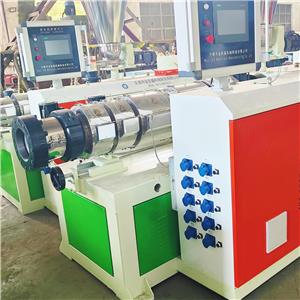
To understand the tool, we must first understand the process. What is an extrusion? At its core, extrusion is a high-volume manufacturing process where raw plastic material (typically pellets) is melted and formed into a continuous profile. Unlike injection molding, which creates individual parts, extrusion creates linear products of infinite length, such as pipes, weather stripping, fencing, and window frames.
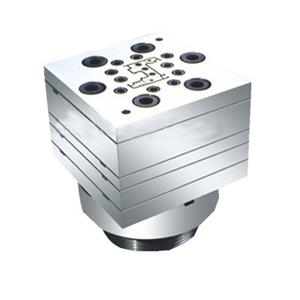
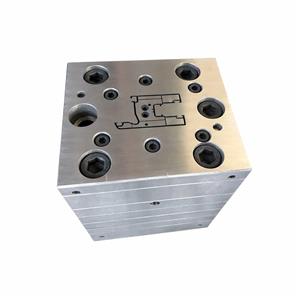
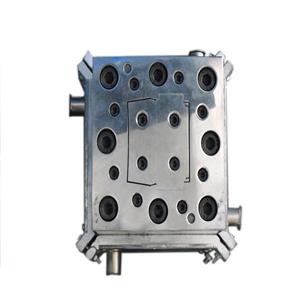
The extrusion die is the custom-engineered steel tool located at the end of the extruder barrel. It is the gatekeeper. It is the final component the molten plastic passes through, and it dictates the shape, surface finish, and dimensional accuracy of the final product.
Think of it like a Play-Doh factory press, but infinitely more complex and operating under extreme heat and pressure. As the molten polymer is pushed through the die, it takes on the shape of the die's cavity. The resulting continuous form is known as the "extrudate."
The Anatomy of a Die
A high-quality extrusion die isn't just a block of metal with a hole in it. It is a sophisticated assembly of varying steel plates, each serving a distinct hydrodynamic function. These components work in unison to transform a chaotic, swirling mass of molten plastic into a smooth, uniform stream.
1. The Adapter Plate
The journey begins here. The adapter plate connects the die assembly to the extruder machine itself. It acts as the bridge. On one side, it typically houses a "counterbore" to accommodate the breaker plate. The breaker plate's job is crucial: it converts the spiraling, rotational motion of the plastic (caused by the extruder screw) into a linear, longitudinal flow. Without this, the plastic would twist as it exits the die, ruining the profile.
2. Transition Plates (Streamlining)
Once the plastic leaves the adapter, it enters the transition plates. This is where the magic of flow engineering happens. The plastic enters as a simple round stream, but it needs to exit as a complex shape—perhaps a square tube or an intricate window profile.
Transition plates gently guide the polymer from that circular inlet toward the final shape. If you try to force the plastic too quickly, it creates stress and turbulence. Therefore, these plates use a series of gradual steps to "streamline" the flow. The number of plates required depends entirely on the complexity of the final extruded plastic dingus (a colloquial industry term for any unspecified plastic part or gadget).
3. The Spider Plate (For Hollow Profiles)
If you are manufacturing a pipe or any hollow profile, you face a physics problem: how do you hold the center pin in place while plastic flows around it? Enter the spider plate.
Located where the molten plastic enters the main die body, the spider plate features several metal legs (or "spiders") that hold the central mandrel (pin) in suspension. The plastic flows around these legs and then re-fuses on the other side. The engineering here must be precise; if the material doesn't re-weld perfectly after passing the spider legs, the final tube will have weak structural lines along its length.
4. The Die Plate and Die Lips
This is the final frontier. The die plate contains the "die land"—a straight section that stabilizes the flow before it exits. The very end of this section is the "die lips." This is the exit door. The lips give the material its final dimensions and surface finish. Any imperfection here—a scratch, a burr, or a misalignment—will be perfectly replicated on miles of product.
5. Co-Extrusion Components
Modern manufacturing often requires multi-material parts, such as a rigid PVC window frame with a soft, flexible seal attached. This is achieved through co-extrusion. Inside the die, specialized flow dividers keep the different materials separate until the very last second. They merge just before exiting the lips, ensuring a strong bond without mixing the distinct properties of the materials.
Challenges with Making A Die
Designing an extrusion die is a battle against physics. Plastic doesn't behave like water; it is a non-Newtonian fluid with complex viscoelastic properties. It remembers stress, it swells upon exiting the die, and it drags against metal surfaces.
The Flow Balance Problem
The single biggest challenge is balancing the flow. In a complex profile, some parts of the wall are thick, while others are thin. Naturally, plastic wants to take the path of least resistance—it will flow faster through the thick sections and slower through the thin ones. If you don't correct for this, the final product will bow, twist, or tear.
Engineers must design the transition plates to artificially restrict flow in the thick areas and encourage flow in the thin areas. This ensures that the material exits the die lips at a uniform velocity across the entire profile.
The Human Element
Even the best die needs a skilled hand to run it. This is where the human element comes in. What is an extrusion operator? They are the specialized technicians responsible for managing the delicate balance of the extrusion line. They monitor temperatures, pressures, and line speeds, making micro-adjustments to ensure the die performs as designed.
A great operator knows that a die is sensitive. If the heater bands are too hot, the plastic degrades. If the cooling bath is too cold, the profile warps. The die is just a tool; the operator is the artist.
Design Limitations
At Zhongjie, we often advise clients on design feasibility. There are limits to what physics allows. For instance, extremely sharp internal corners are difficult because plastic tends to "bridge" across them. Similarly, very thin walls (under 0.020”) combined with heavy sections can cause cooling rates so different that the part warps inevitably.
When searching for a plastic extrusion die in china, it is vital to find a partner who understands these limitations and can guide your product design toward manufacturability before steel is ever cut.
Work With The Extrusion Die Experts
In the competitive landscape of manufacturing, your tooling is your foundation. A poorly designed die results in slower line speeds, higher scrap rates, and inconsistent product quality—costs that accumulate every single minute the machine is running.
At Zhongjie, we don't just build dies; we engineer solutions. With over 30 years of experience, we have mastered the art of flow dynamics. Whether you need a standard profile or a complex solid baseboard co-extrusion mold, our in-house capabilities allow us to control every aspect of quality and timeline.
We utilize state-of-the-art CNC machining and high-grade stainless steels to ensure our dies offer exceptional longevity and dimensional stability. Our team understands that for our Western partners, reliability and communication are just as important as the steel itself.
Summary
An extrusion die is far more than a simple mold; it is a complex instrument of hydrodynamic engineering. From the adapter plate to the die lips, every millimeter of steel must be calculated to control the flow of molten polymer. By understanding the function of these components and the challenges of flow balancing, manufacturers can better appreciate the value of high-quality tooling. Partnering with an experienced manufacturer like Zhongjie ensures that your extrusion process is efficient, consistent, and profitable from day one.